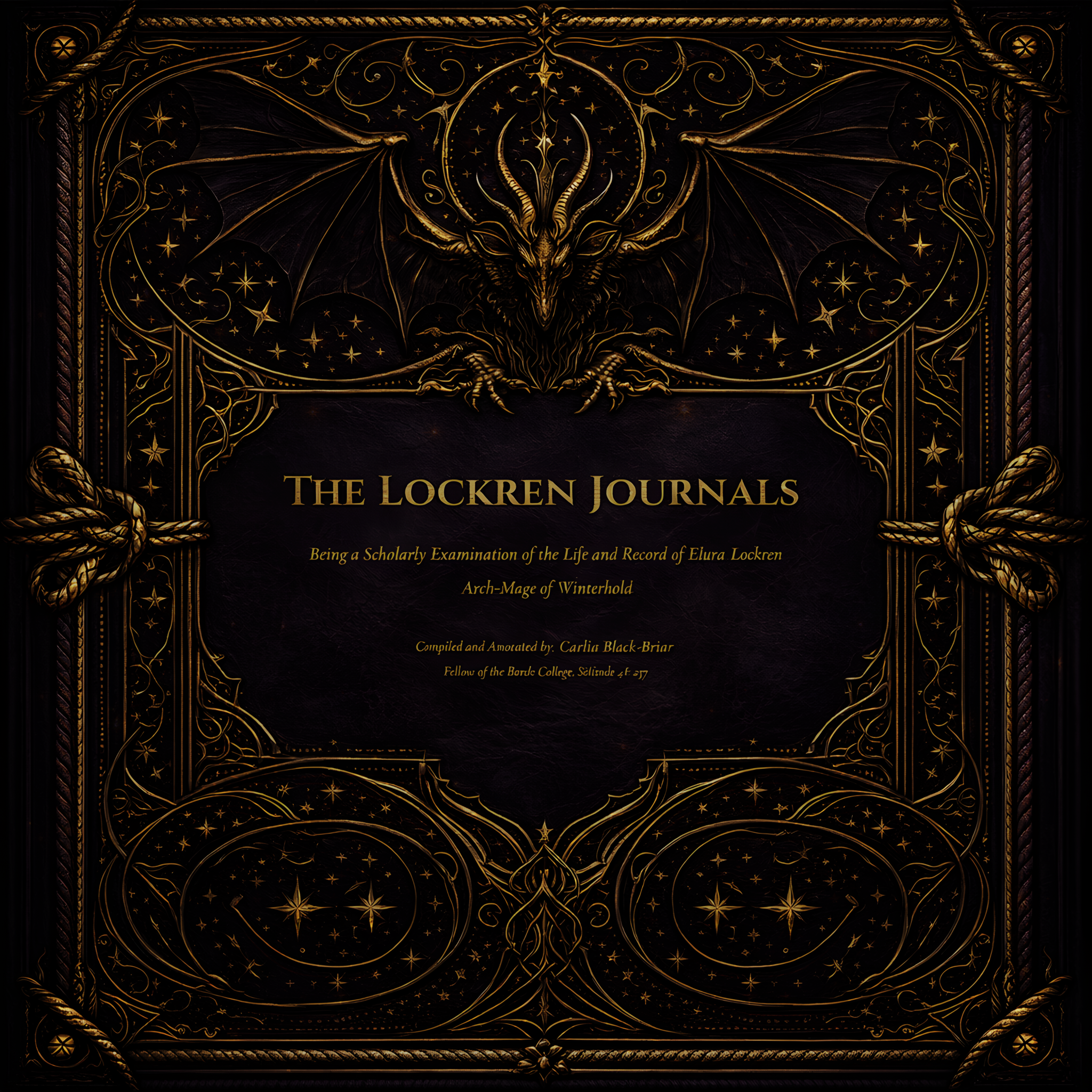
This is a project that snowballed in scope, and became more than I ever intended.
It started simple. I've been playing various forms of Skyrim, modded and otherwise, since its release, and I tend to fall into the inevitable trap: the stealth archer. Along with that comes a kind of "productivity loop" where everything is built to serve leveling and becoming more powerful while "wasting" as little time as possible. Skyrim turns into this dumb second job. Every crafted dagger gets marched up to the Dragonreach enchanting table, every creature killed has to feed a soul gem, and at some point you stop and wonder if you're actually playing a game at all.
So I built a character more deliberately, loosely based on a D&D-style character sheet. Then actually play as that character. To maintain consistency, I started keeping a journal of what happened, interpreting events through the emotional lens of the character and following what felt like reasonable development. It is heavily AI-assisted, though "written by AI" doesn't feel correct. The approach was to teach the AI who Elura is through the character sheet, then give it rough outlines from my playthrough. It produces a draft, and I go back through and rewrite where needed to make sure the character actually feels human. AI tends to miss emotional beats or humor.
That worked well, but it started to spiral. The writing itself became too much fun. As a fan of The Princess Bride, it occurred to me that adding a second character to analyze the first would be funny. Adding a second AI to analyze the first, turns into another layer of meta-nonsense. Skyrim is a game that is fundamentally unserious while being written with complete earnestness. One moment it's the end of the world, the next a bandit is glitching through a chair and launching into the sky. So the whole thing became a kind of absurdist meta-joke. None of it is meant to be taken too seriously.
The odd part is that the characters started to feel real anyway. The tone shifted and what started as something light and self-aware became more introspective. I tend to think in systems. Everything becomes a chain of "this to this," and what can be optimized next. Feelings usually come after pragmatic conclusion. That is Elura. Caelia, the second voice, exists as a counterbalance. Writing her, especially with AI involved, forced me to confront my own biases in how I interpret events. As the characters became more coherent, the project became more meaningful.
The game itself began as a fairly standard modded Skyrim. Visual improvements, gameplay tweaks, camera adjustments, some adult content layered in, including Devious Devices. I hadn't really examined why that framework worked so well for me until this project.
Skyrim, at its core, is about progress and power. It was described once to me as a "murder, kill, steal simulator," and that isn't entirely wrong. Given enough time, the player becomes effectively invincible. Additionally you become the most important character in the game world, and the world barely reacts. Consequence doesn't really exist. Power is inevitable.
The Devious framework changes that. It introduces friction—real inconvenience, frustration, and loss of control. It creates problems that can't be solved by simply becoming stronger. For me, that makes the world more engaging. It interrupts the loop where everything trends toward optimization and replaces it with something less predictable.
The writing tries to stay faithful to Elura's experience without becoming explicitly pornographic. It's an attempt to make Skyrim feel like a human experience, filtered through someone who is analytical and pragmatic. That said, it remains what I would call "horny adjacent."
From there, the project expanded again. I experimented with AI-generated imagery to capture specific moments. That worked well enough to justify building a controlled local pipeline to maintain character consistency across scenes. Then Caelia's bardic perspective made music inevitable, and tools like Suno provided a way to match sound to her writing.
At a certain point, this stopped feeling like something I "wrote" in a traditional sense. Director or producer is probably a more accurate description. I very much feel ownership over the work and the decisions behind it. Though I can't reasonably claim authorship of the music, I am not a musician.
What I built is a system. Rules, constraints, and tools, then participated inside it. The result feels less like a story I authored, and more like something I discovered by staying inside it long enough.